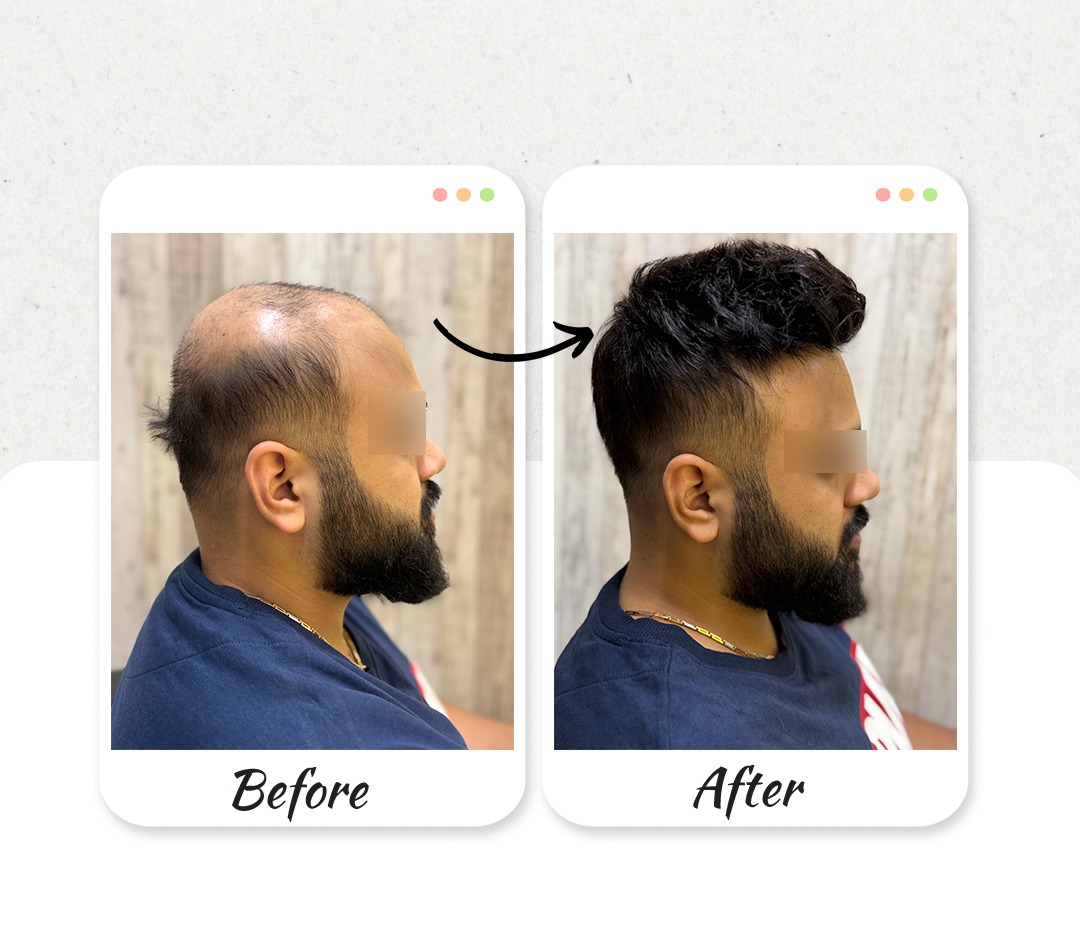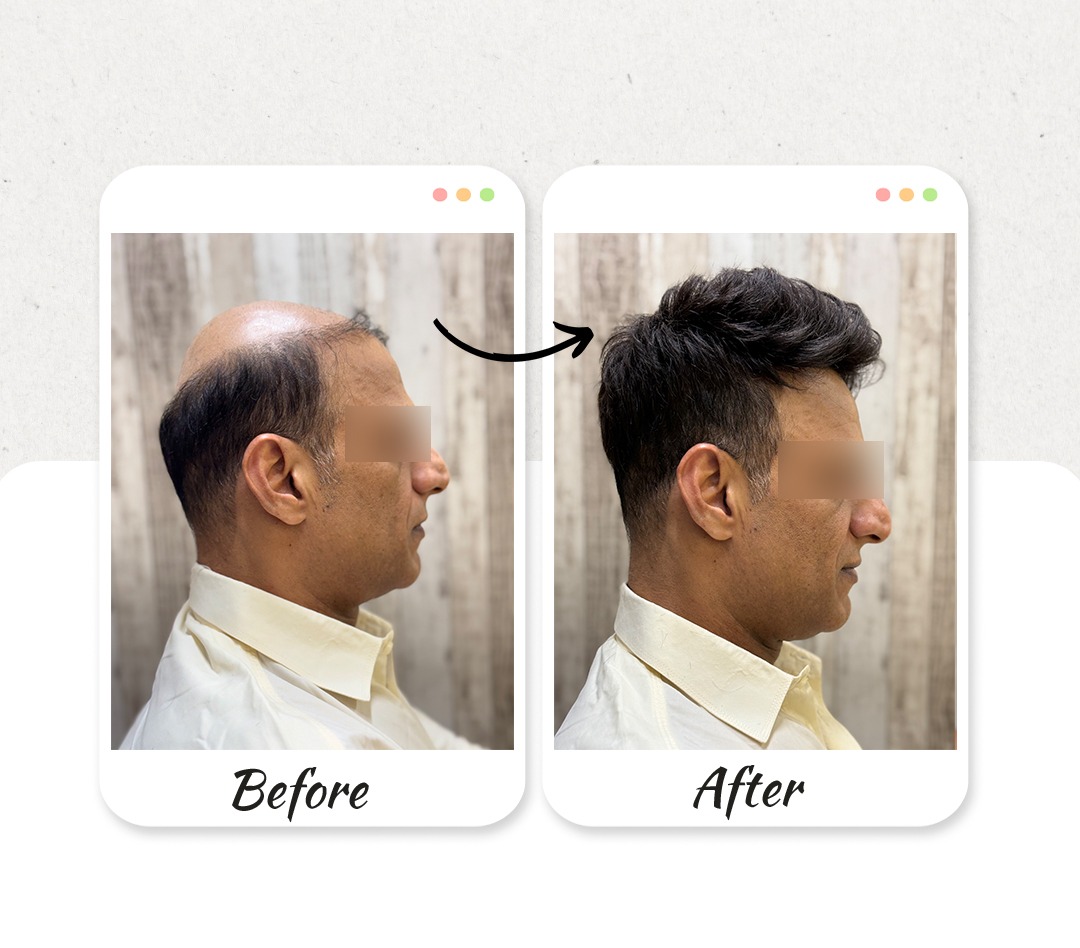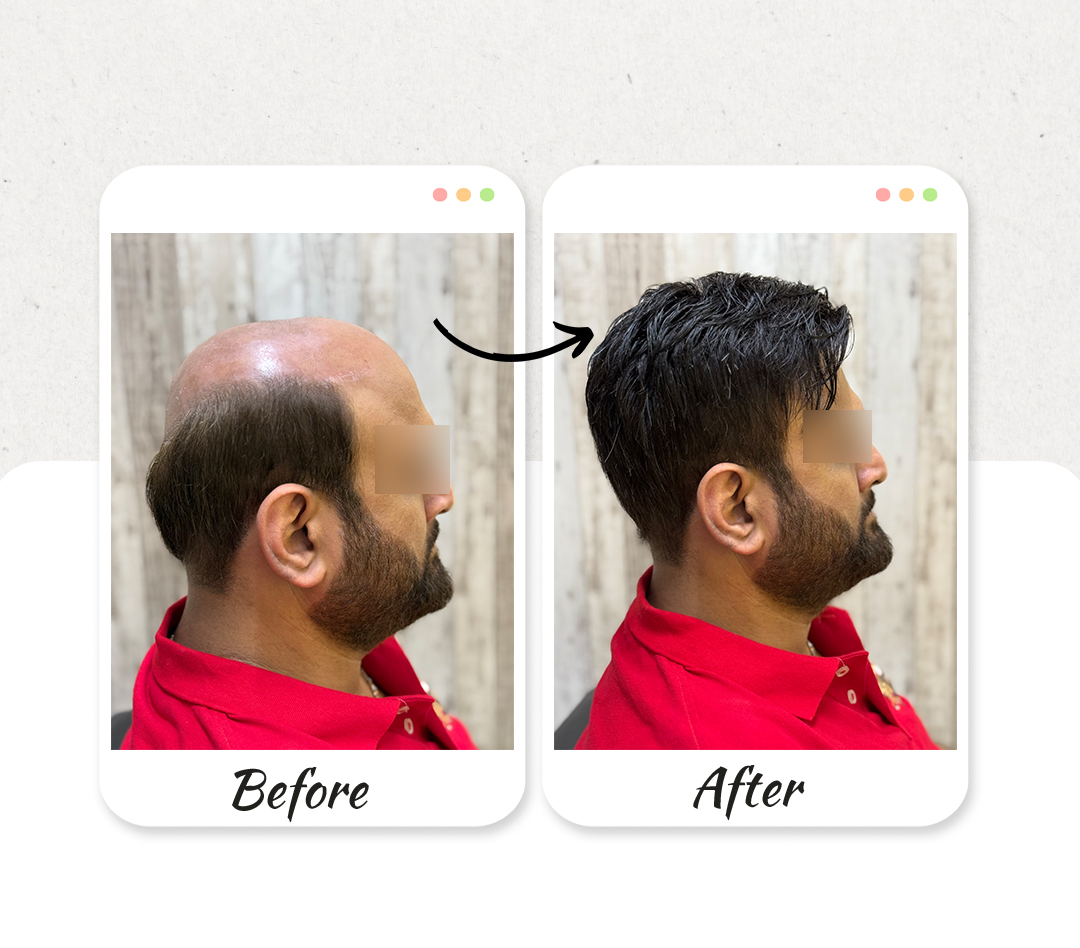
The question comes up in almost every first consultation. Not always in those exact words; sometimes it’s phrased as “will people be able to tell?” or “how natural does it actually look?”, but the underlying concern is always the same. People want to know whether this will work in real life. Not in studio lighting. Not in a carefully staged before-and-after photo. In the office, at a family dinner, in sunlight, up close.
It’s a fair query, and it deserves a straight answer rather than reassuring generalisations.
The honest answer is: yes, a hair patch can look completely natural. But it doesn’t happen automatically. It depends on a specific set of variables, the quality of the system, the accuracy of the customisation, the skill of the application, and how well the aftercare is maintained. When all of these are in place, the result is genuinely indistinguishable from natural hair growth. When any one of them is compromised, that’s usually where the “unnatural” quality comes from.
Let’s go through each of these in detail, because understanding what creates a natural result is also the clearest guide to knowing what to look for and what to expect.
The Quality of the Hair Itself
Everything starts here. A hair patch made from synthetic fibres will always have limitations. The way light reflects off synthetic hair is slightly different from natural hair; the texture tends to feel uniform in a way that real hair doesn’t, and synthetic hair cannot be styled with heat the way natural hair can. For someone who wants a result that holds up under scrutiny, synthetic hair has a ceiling.
Human hair patches, specifically those made from Remy hair, where the cuticles are aligned in the same order, behave like real hair because they are real hair. They absorb light the same way. They move the same way. They respond to humidity, wind, and touch in a way that matches your natural hair because the material is the same.
At Hair Destination Studio, all hair patches are built with 100% natural human Remy hair. This isn’t just a quality preference; it’s the foundation of everything that follows. You cannot achieve a truly natural result on a compromised base material, no matter how skilled the application.
The Hairline: Where Natural Results Are Won or Lost
If you look closely at someone wearing a poorly made hair patch, the hairline is almost always where the problem is visible. A hairline that is too sharp, too uniform, or too perfectly straight looks nothing like hair that grows naturally from a scalp.
Natural hairlines are irregular. They have soft, fine hairs at the very front that gradually transition into fuller hair further back. They have slight variations in direction: some hairs grow slightly forward, some sideways, some at an angle. The density at the very edge is lighter than the density a centimetre behind it. This is what makes a hairline look like it belongs to a face rather than sitting on top of one.
A natural-looking hair patch replicates all of this. The base at the hairline is thin enough that the scalp is visible through it in the way it would be through natural hair. The hairs at the front edge are fine and sparse, with density gradually increasing toward the crown. Each strand at the hairline is individually placed at an angle that mirrors how hair actually grows in that area.
This level of detail is what separates a natural-looking hair patch from one that looks like a hairpiece. It cannot be achieved with a generic, off-the-shelf product. It requires customisation, which brings us to the next factor.
Customisation: The Difference Between “Good” and “Undetectable”
A hair patch that matches your colour, texture, density, and hairline pattern precisely is a very different thing from a hair patch that approximates these qualities. The difference between the two is often the difference between a result that is “pretty good” and one that nobody notices.
Colour matching goes beyond selecting the right shade from a chart. Natural hair has tonal variation, lighter strands, darker roots, perhaps some grey at the temples. A flat, single-tone colour in a hair patch stands out precisely because real hair doesn’t behave that way. Accurate colour matching accounts for the full range of tones in your natural hair, not just the dominant shade.
Texture matching means selecting a wave pattern and strand behaviour that matches what your own hair does naturally. If your hair has a slight wave, a straight-textured patch will create a visible inconsistency at the blend points, particularly at the sides and back where the patch meets your natural hair.
Density matching is one of the most commonly overlooked variables. A patch noticeably denser than your surrounding natural hair creates an immediately apparent visual imbalance. The patch should match the volume of your natural hair, not exceed it. For most people, a medium density is the right starting point, with adjustments made based on age, hair type, and the size of the area being covered.
Transitional density at the hairline, finer at the very front, gradually fuller toward the crown, is the customisation detail that has the single biggest impact on natural appearance. Hair Destination Studio offers this level of specification as part of the customisation process, and it is one of the clearest markers of a professionally made system versus a generic one.
The Base Material: What Sits Against Your Scalp
The base of a hair patch, the material the hair is attached to, which sits against your scalp, has a significant impact on both the appearance and the comfort of the system.
Thicker, more rigid bases are easier to work with in some respects, but they create a visible edge where the patch meets the scalp, particularly in strong light or when the hair is moved. They also tend to feel less natural to the touch.
Skin-thin bases and fine lace bases are designed to be effectively invisible against the scalp. When properly fitted and colour-matched to your skin tone, the base disappears; all that’s visible is the hair appearing to grow directly from your scalp, which is exactly the effect you’re after. These bases also allow the hair to be parted and styled in multiple directions, because there’s no visible grid or structure underneath.
The right base material depends on your lifestyle, how active you are, and what attachment method you’re using. A professional consultation will take all of these into account rather than defaulting to one option for everyone.
The Application: Precision Is Everything
The best hair in the world, perfectly customised, will not look natural if the application is imprecise. The placement of the patch, how accurately it sits relative to your natural hairline, how evenly the base lies against the scalp, and how cleanly the adhesive is applied determine whether the system looks like part of you or something placed on top of you.
This is why professional application matters. It is not a step that rewards shortcuts. An experienced specialist knows how to position the patch correctly for your specific head shape and hair growth pattern, how to work the hairline edge so it blends rather than demarcates, and how to ensure the base lies flat without any visible lifting or bubbling.
What the First Few Weeks Actually Feel Like
Most people who get their first hair patch fitted report a period of adjustment, not because the patch looks unnatural, but because they’re not yet used to seeing themselves with a full head of hair. The mirror reflection looks different from what they’ve grown accustomed to, and that takes a little time to settle.
What most people don’t expect is how quickly it stops feeling like something they’re wearing and starts feeling like simply having hair again. Within a few weeks, the daily routine- washing, styling, going about their day- becomes entirely normal. The self-consciousness fades. Checking and rechecking in mirrors becomes less frequent. And at some point, most people realise they’ve stopped thinking about it altogether, which is arguably the clearest sign that the result is working.
Honest Expectations: What a Hair Patch Will and Won’t Do
A hair patch will give you a full, natural-looking head of hair that you can wash, style, and live with daily. It will look natural in sunlight, in photographs, and in the presence of people who are not actively looking for a hairpiece. It will give you back the appearance, and often the confidence, that hair loss had taken away.
What it won’t do is maintain itself without care. Regular reattachment, appropriate product use, and periodic professional servicing are part of the commitment. These are not burdensome requirements; they become routine quickly, but they are real ones.
It also won’t perform at its best if the initial customisation is not done properly. The natural appearance that a hair patch can achieve is directly tied to the accuracy of the matching and the quality of the application. This is why choosing the right studio matters as much as choosing the right system.
See It for Yourself
The clearest way to answer the question “Can it look completely natural?” is to see what’s possible in person, on your own face, matched to your own hair. A photograph or a description can only go so far.
Hair Destination Studio offers free consultations at our Powai and Malad branches in Mumbai. Our team will assess your natural hair, discuss what you’re looking for, and show you what a properly customised hair patch looks like in practice, not in theory. There’s no obligation involved, and no pressure.
If you’ve been wondering whether a hair patch could work for you, that conversation is the most useful place to start.