Most men don’t lose their hair all at once. It happens slowly, quietly, in small ways that are easy to explain away. The shower drain looks a little fuller than usual — must be the new shampoo. The parting seems slightly wider — probably just the lighting. The hairline looks different in photos — bad angle, surely.
The problem with male pattern baldness is that it rewards early action and punishes delay. By the time most men take it seriously, they’ve already lost significant ground — ground that becomes harder, and sometimes impossible, to recover depending on the path they choose.
What most people don’t realise is that the window between “something is changing” and “I need to make a real decision” is shorter than it looks. And the decisions available to you at that window — between hair transplant vs. non-surgical hair replacement, between reactive and proactive — are very different depending on how much hair you have left to work with.
So here are the five signs that are worth paying attention to right now, before that window narrows.
1. Your Hairline Is Moving — Even Slightly
This is the one men notice first and dismiss fastest. A hairline that shifts by even a centimetre over six months is not normal variation. It’s the earliest visible indicator of androgenetic alopecia — the clinical term for male pattern baldness — and it typically begins at the temples.
What to look for: compare a photo from two years ago with one taken recently. Don’t look at how you style your hair. Look at where your hairline actually sits relative to your forehead. If there’s a measurable difference, that’s not imagination.
The temple recession is significant because it’s where most men start, and it follows a predictable path. Left unaddressed, those two receding corners eventually meet in the middle — creating the classic M-shaped hairline that signals moderate-to-advanced hair loss.
Here’s the thing about catching it here: at this stage, your options are widest. Both hair transplant and non-surgical hair replacement can address early hairline recession effectively. The difference is timeline, cost, and recovery — which we’ll get to.
2. You’re Losing More Hair Than Usual — and It Isn’t Growing Back
Losing 50 to 100 hairs a day is completely normal. Hair has a growth cycle, and shedding is part of it. What’s not normal is when that shedding consistently exceeds the regrowth — when the hair coming out in the shower, on the pillow, or caught in your comb is no longer being replaced at the same rate.
The key word here is consistently. A stressful week, a poor diet, or an illness can cause temporary shedding. But if you’ve noticed heavier-than-usual hair fall for more than two to three months with no obvious cause, that pattern deserves attention.
Run a simple test: pull your fingers gently through a section of hair at the crown. If more than six to eight hairs come away easily, it could indicate active thinning in that area. This isn’t a diagnostic tool — but it’s a signal worth taking to a professional.
3. Your Crown Is Thinning — Even If Your Hairline Looks Fine
Male pattern baldness doesn’t always start at the front. For a significant number of men, it begins at the crown — that circular patch at the top of the head that you can only really see in a mirror held overhead, or in a photo someone else takes of you.
This is why crown thinning tends to catch men off guard. They check the mirror daily, see a hairline that seems intact, and assume everything is fine — until a family member points it out, or a photo from above tells a different story.
What makes crown thinning particularly relevant to the hair transplant vs. non-surgical hair replacement conversation is this: the crown is one of the most challenging areas to address surgically. Transplants in the crown area require a high number of grafts, and results can look uneven if hair loss continues to progress after the procedure. Non-surgical hair systems, by contrast, cover the crown completely and adapt as loss progresses — without needing a second procedure.
4. Your Hair Has Lost Volume and Texture
Before hair visibly disappears, it often miniaturises. The individual strands become finer, lighter, and shorter — a process driven by dihydrotestosterone (DHT) gradually shrinking the hair follicles over successive growth cycles.
If your hair feels different — limper, thinner between your fingers, less responsive to styling products that used to work — that’s not your imagination and it’s not your shampoo. It’s miniaturisation, and it’s one of the clearest early biological markers of pattern baldness.
This stage matters because it’s often invisible in photos and easy to attribute to external factors. Men at this stage frequently spend months or years trying different shampoos, supplements, and oils before realising the cause is hormonal and progressive — and that topical products alone rarely reverse it once the process is underway.
In our experience at Hair Destination Studio, many clients who come in for consultations are at exactly this stage — the hair is still there, but it has clearly changed. This is precisely when intervention gives you the best outcomes, regardless of which route you take.
5. You’re Styling Differently to Hide It
This one is more psychological than physical — but it’s arguably the most telling sign of all.
Are you parting your hair differently than you used to? Using more product to create the appearance of fullness? Avoiding certain hairstyles, hats, swimming, or photos? Positioning yourself in group pictures so your thinning isn’t caught on camera?
If your daily routine now includes any unconscious management of how your hair looks to others, your brain has already registered the problem — even if you haven’t acted on it yet. This kind of low-level anxiety around hair loss is something thousands of men carry silently, and it compounds over time.
The sooner you address what’s actually happening, the sooner that mental overhead disappears.
So You’ve Noticed the Signs — What Now?
This is where most articles stop. They list the signs, suggest you “see a dermatologist,” and leave you no closer to understanding your real options. Let’s be more useful than that.
When it comes to addressing male pattern baldness, the two most talked-about solutions in 2025 are hair transplant and non-surgical hair replacement. And the comparison between them is not as straightforward as most people assume.
Hair transplant works by surgically relocating follicles from your donor area to thinning regions. It’s a permanent solution — but it requires a sufficient donor supply, significant recovery time (10–14 days minimum), a budget of anywhere from ₹50,000 to ₹2,00,000+, and 12 to 18 months of waiting before you see full results. It also cannot reverse miniaturisation or cover areas where the donor hair simply doesn’t exist.
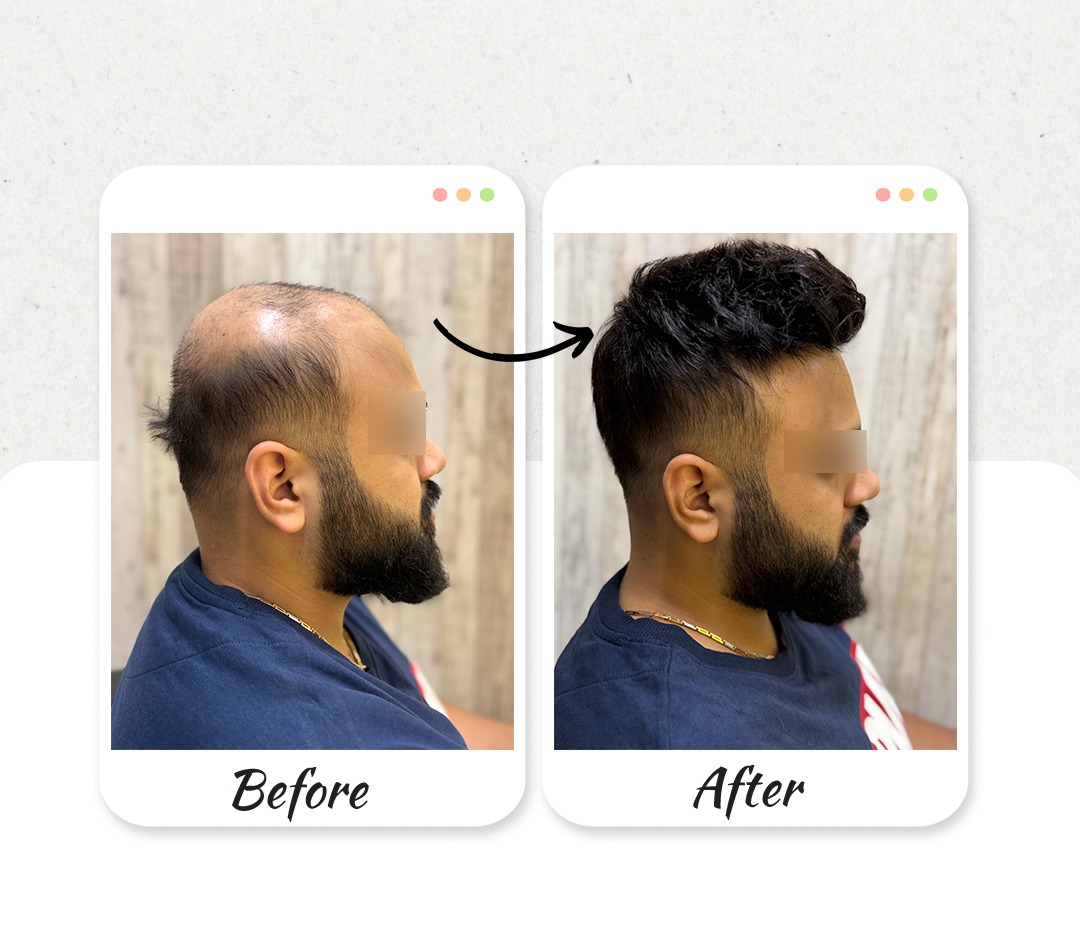
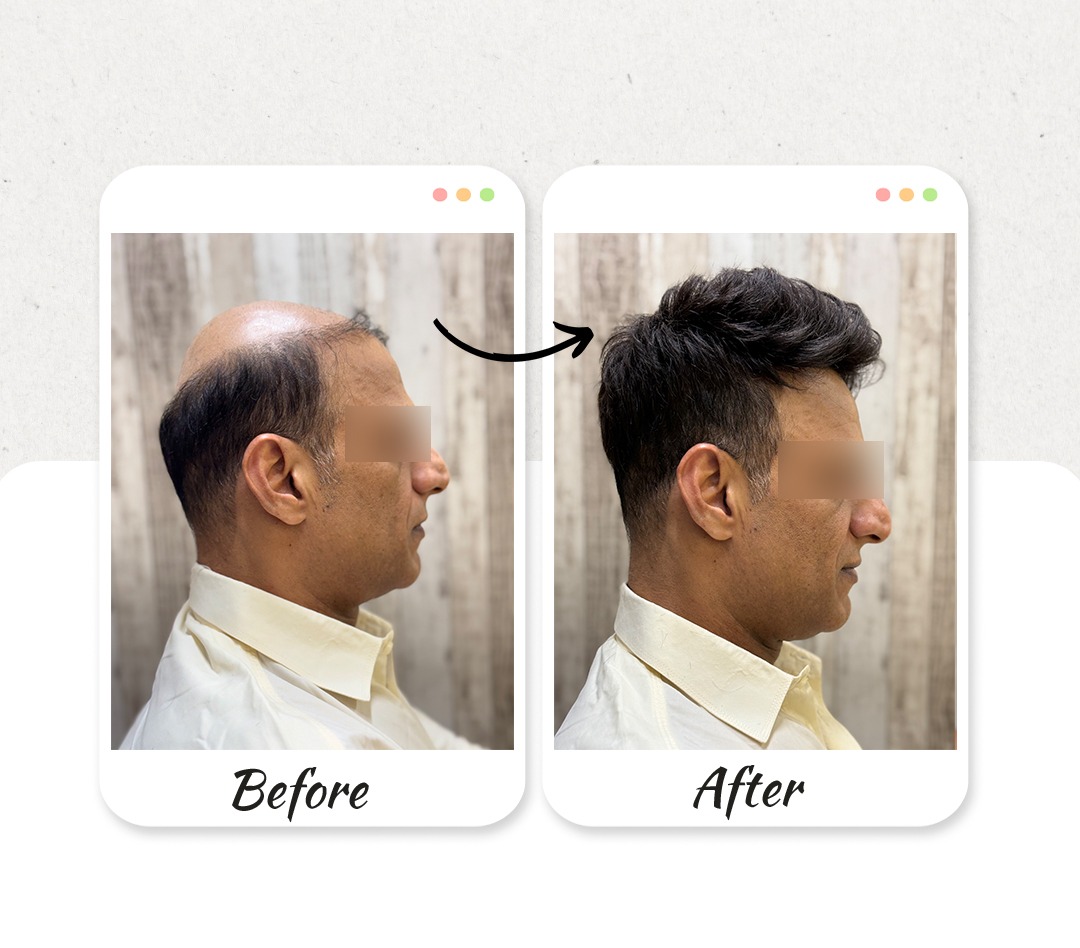
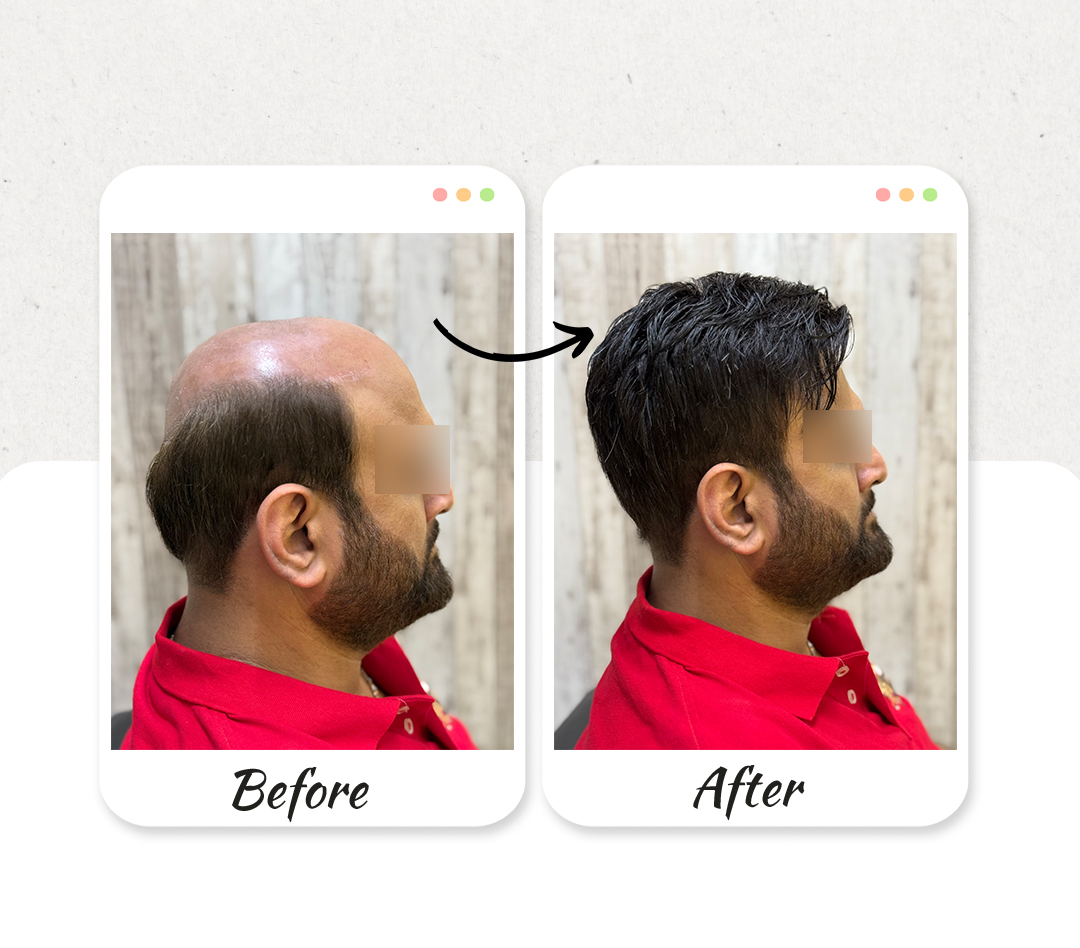
Non-surgical hair replacement — the kind offered at Hair Destination Studio using US-based techniques and 100% natural human Remy hair — delivers full coverage from day one. There’s no surgery, no recovery, no waiting. The system is custom-built to match your hair colour, texture, density, and hairline, and fitted strand by strand so it moves and parts exactly like real hair. For men at any stage of hair loss — early or advanced — it works. And it costs a fraction of what surgical options demand.
The honest answer to “which is better” depends on your stage of hair loss, your lifestyle, your budget, and how quickly you need results. What we consistently see at Hair Destination Studio is that men who catch the signs early have the most options — and the best outcomes.
Don’t Wait for the Mirror to Force the Decision
The five signs above don’t all have to be present for action to make sense. Even one of them, noticed consistently over several weeks, is worth taking seriously.
At Hair Destination Studio, we offer free consultations — no pressure, no commitment. Our team will assess where you actually are in your hair loss journey, walk you through what non-surgical hair replacement could look like for your specific pattern, and give you an honest picture of your options before you decide anything.
Hair loss moves slowly enough to ignore — until it doesn’t. The men who act early are the ones who stay ahead of it.
Call us at +91 88283 81386 or visit our Powai or Malad studio to book your free consultation today.